
Hokusai in Rome: Beyond The Great Wave — A Timeless Journey Through Japanese Art
Updated: Jul 28
Hokusai in Rome: Beyond The Great Wave — A Timeless Journey Through Japanese Art. The Fine Art Ledger visits the landmark Hokusai exhibition at Palazzo Bonaparte, Rome
"Hokusai is not just an artist among others in the floating world; he is an island, a continent, a world all by himself."
— Edgar Degas
Some artists become famous but only a precious few redefine how the world sees art.
Katsushika Hokusai (1760–1849) belongs firmly in the latter category. More than 175 years after his death, his work continues to inspire artists, collectors, museums, designers and scholars across the globe. His influence stretches from nineteenth-century Impressionism to contemporary graphic design, while his most celebrated image, The Great Wave off Kanagawa, remains one of the most recognizable works of art ever created.
During a recent visit to Rome, The Fine Art Ledger experienced Hokusai – Il grande maestro dell'arte giapponese at Palazzo Bonaparte, one of Europe's most important Hokusai exhibitions in recent years.
Running from 27 March through 29 June 2026, the exhibition brought together more than 200 original works, including woodblock prints, paintings, illustrated books and drawings, offering visitors an exceptional opportunity to experience the extraordinary breadth of Hokusai's career.
Presented by Arthemisia in collaboration with the Hokusai-kan Museum, the exhibition was widely promoted as the largest ever dedicated to Hokusai in Italy. It was made possible through an exceptional loan from the National Museum in Kraków, Poland, whose internationally renowned collection of Japanese art formed the heart of the exhibition. For many visitors, it represented a rare opportunity to experience one of Europe's finest collections of Hokusai's work.
From the moment visitors entered the galleries, it became clear that this exhibition was about far more than one famous print. It was an invitation into the artistic world of a man whose curiosity never seemed to diminish.
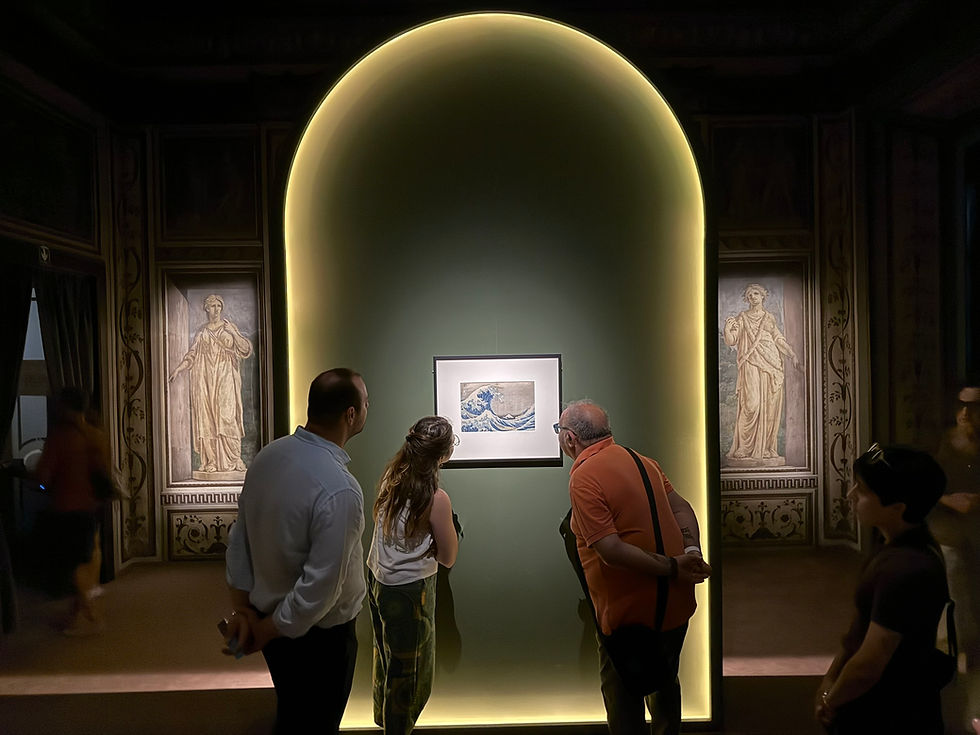
Beyond The Great Wave
For many people, Hokusai is synonymous with The Great Wave off Kanagawa. Standing before the original print, however, quickly changes that perception.
Created around 1831, The Great Wave is the opening print in Hokusai's celebrated series Thirty-six Views of Mount Fuji. While the immense wave dominates the composition, Mount Fuji quietly anchors the horizon beneath it. At first glance it almost disappears, yet it remains the calm, permanent center of an image otherwise filled with motion and uncertainty.
The wave appears alive, curling over the tiny fishing boats below, while Mount Fuji stands undisturbed in the distance. Hokusai captures not simply a moment in nature, but a profound contrast between the immense power of the sea and the enduring permanence of the mountain.
The exhibition reunited The Great Wave with other selections from Thirty-six Views of Mount Fuji, allowing visitors to appreciate the series as Hokusai may have intended. Mount Fuji appears again and again under changing skies, seasons and weather conditions. Sometimes it dominates the landscape. Elsewhere it quietly recedes into the background while farmers, fishermen, merchants and travelers continue with everyday life.
Seen together, the series becomes far richer than a collection of landscapes. It is an exploration of humanity's relationship with nature and of finding beauty in ordinary moments.
A Master Who Never Stopped Experimenting
Although The Great Wave inevitably attracts the largest crowds, the exhibition reveals an artist of extraordinary range.
Visitors move through galleries filled with waterfalls, birds, flowers, dragons, landscapes, illustrated books, portraits and scenes from everyday Edo-period Japan.
What becomes immediately apparent is Hokusai's restless curiosity.
His compositions feel remarkably modern even today. Dramatic cropping, unconventional viewpoints, flattened perspective and sophisticated use of negative space would later inspire European artists including Claude Monet, Vincent van Gogh, Edgar Degas and Henri de Toulouse-Lautrec during the rise of Japonisme.
Standing among these original works, one begins to understand why so many Western artists regarded Hokusai not simply as an influence, but as revelation.

Extraordinary Craftsmanship That Has Defied Time
One of the greatest surprises of the exhibition is just how remarkably well these works have survived. Many visitors arrive expecting fragile prints whose colours have faded with age.
Instead, they encounter works whose blues remain vibrant, whose carved lines remain astonishingly sharp and whose paper appears remarkably fresh despite being nearly two centuries old.
The reason lies in the extraordinary craftsmanship behind Japanese woodblock printing.
Each image required the combined expertise of artist, engraver, printer and publisher. Every color demanded its own carved woodblock, aligned with extraordinary precision before successive layers of pigment were applied by hand.
Equally important was the paper itself. Hokusai's prints were produced on traditional washi , handmade from the inner bark of the mulberry plant (Kozo (paper mulberry) bush)). Unlike many Western papers manufactured from wood pulp, washi contains exceptionally long fibers and is naturally acid-free, making it extraordinarily durable.
The exhibition explains that well-made washi can survive for more than one thousand years, helping explain why Hokusai's original prints continue to retain such remarkable richness and clarity today. Washi papermaking itself was recognized by UNESCO as Intangible Cultural Heritage in 2014.
Standing before these original prints, it becomes impossible not to admire not only Hokusai's genius but also the remarkable skill of the craftsmen whose work has allowed these masterpieces to survive in such exceptional condition.
A Remarkable Collection from Kraków
The exhibition owes much of its significance to the collection itself. The works on display were drawn principally from the National Museum in Kraków, home to one of Europe's most important collections of Japanese art. The museum's Hokusai holdings are internationally recognized for both their quality and remarkable state of preservation.
For visitors to Rome, the exhibition represented an extraordinary opportunity to experience masterpieces that seldom travel internationally, making the exhibition feel all the more special.

Poetry Among the Prints
The exhibition was carefully curated to encourage reflection rather than simply observation. Throughout the galleries, quotations from artists and Japanese poets accompanied the artworks.
One wall featured Edgar Degas' famous tribute to Hokusai:
"Hokusai is not just an artist among others in the floating world; he is an island, a continent, a world all by himself."
On the reverse of the panel holding The Great Wave, visitors encountered a haiku by Matsuo Bashō:
"The sea darkens.
The cry of wild geese—
Something white"
These thoughtful additions slowed the pace of the exhibition, encouraging visitors to spend time with each work rather than simply moving from one famous print to the next.
It was a beautifully curated reminder that Japanese art has always been deeply connected with poetry, observation and the quiet appreciation of nature.
An Immersive Finale
One of the exhibition's most memorable moments arrived at its conclusion.
Visitors stepped into an elegant all-glass mirrored room, where reflections multiplied Hokusai's imagery into seemingly endless perspectives, replete with floor to ceiling mirrors and videos of dragons crashing through waves.
The installation created a striking dialogue between historical masterpieces and contemporary exhibition design. Landscapes, waves and visitors themselves became part of an ever-changing composition.
It was both playful and contemplative—a fitting conclusion to an exhibition devoted to an artist whose work continues to transcend time and geography.
Why Hokusai Still Matters
The Rome exhibition attracted more than 80,000 visitors during its first month, demonstrating that Hokusai's work continues to resonate with audiences from around the world. Even when The Fine Art Ledger arrived at the exhibition in the middle of June, almost at the end of its run, a line of people waited to enter ahead of us
Walking through Palazzo Bonaparte, it becomes clear that Hokusai's legacy rests on far more than The Great Wave. It lives in the remarkable craftsmanship of Japanese woodblock printing. It lives in the enduring strength of traditional washi paper. It lives in the countless artists he inspired across Europe and beyond.
And it lives in the quiet power of works that continue to reward careful observation nearly two centuries after they were created.
Perhaps Edgar Degas captured it best. Hokusai was never simply another artist.
He created an artistic world entirely his own that has survived the centuries and still fuels our imaginations and provides the same feelings of peace and serenity today. Certainly an Island of calm in many respects, with this exhibition right in the heat and bustle of a very hot Rome at the end of the ancient Via del Corso.
Frequently Asked Questions
What is the Hokusai exhibition at Palazzo Bonaparte in Rome?
Hokusai – Il grande maestro dell'arte giapponese was a major exhibition held at Palazzo Bonaparte in Rome from 27 March to 29 June 2026. The exhibition featured more than 200 original works by Katsushika Hokusai, including woodblock prints, paintings, illustrated books and drawings. The exhibition was presented by Arthemisia in collaboration with the Hokusai-kan Museum and was largely drawn from the renowned collection of the National Museum in Kraków, Poland.
Is The Great Wave off Kanagawa part of Thirty-six Views of Mount Fuji?
Yes. The Great Wave off Kanagawa is the first and most famous print in Hokusai's Thirty-six Views of Mount Fuji series. Originally published around 1831, the series explored Mount Fuji from different locations, seasons and weather conditions. Due to its popularity, Hokusai later expanded the series from 36 to 46 prints.
Why is The Great Wave off Kanagawa one of the world's most famous artworks?
The Great Wave off Kanagawa is celebrated for its dramatic composition, technical brilliance and universal symbolism. The towering wave, small fishing boats and distant Mount Fuji create a powerful image of nature's force and humanity's resilience. It has become one of the most reproduced and recognizable artworks in history.
Who was Katsushika Hokusai?
Katsushika Hokusai (1760–1849) was one of Japan's greatest artists and printmakers. Best known for his ukiyo-e woodblock prints, Hokusai produced thousands of works during a career spanning more than seventy years. His innovations in composition, perspective and landscape art influenced generations of artists, including Claude Monet, Vincent van Gogh and Edgar Degas.
What is ukiyo-e?
Ukiyo-e translates as "pictures of the floating world" and refers to a style of Japanese woodblock printing and painting that flourished during the Edo period. Ukiyo-e artists created prints depicting landscapes, actors, beautiful women, historical events and scenes from everyday life. Hokusai is widely regarded as one of the greatest masters of the ukiyo-e tradition.
Why have Hokusai's original woodblock prints survived for nearly 200 years?
Many of Hokusai's original prints were produced on traditional washi paper, handmade from the inner bark of the mulberry plant. Washi is naturally acid-free, exceptionally durable and resistant to deterioration. Combined with careful museum conservation, these qualities have allowed many original Hokusai prints to retain their colour, detail and structural integrity for almost two centuries.
What is washi paper?
Washi is a traditional Japanese handmade paper known for its exceptional strength, flexibility and longevity. Made from natural plant fibers rather than wood pulp, washi has been used for centuries in Japanese printmaking, calligraphy and book production. UNESCO recognized traditional Japanese washi papermaking as an Intangible Cultural Heritage in 2014.
Where were the artworks in the Rome Hokusai exhibition on loan from?
The exhibition was principally drawn from the internationally renowned collection of the National Museum in Kraków, Poland, which houses one of Europe's finest collections of Japanese art. The loan provided visitors with a rare opportunity to see masterpieces that are seldom exhibited outside Poland.
Why is Mount Fuji featured so prominently in Hokusai's work?
Mount Fuji is Japan's highest mountain and one of the country's most important cultural and spiritual symbols. In Thirty-six Views of Mount Fuji, Hokusai explored the mountain from different perspectives, using it as a constant presence within changing landscapes and everyday life, reflecting themes of permanence, nature and the passage of time.
How did Hokusai influence Western art?
Hokusai's innovative use of perspective, asymmetrical composition, bold cropping and dynamic movement had a profound influence on European artists during the nineteenth century. His work inspired leading Impressionist and Post-Impressionist painters, including Claude Monet, Vincent van Gogh, Edgar Degas, Henri de Toulouse-Lautrec and many others, helping shape the development of modern art.
Why is the Rome Hokusai exhibition significant?
The Palazzo Bonaparte exhibition brought together one of the finest collections of Hokusai's work ever displayed in Italy. By presenting original woodblock prints alongside paintings, illustrated books and drawings, it offered visitors a comprehensive view of Hokusai's artistic achievements while highlighting the extraordinary craftsmanship behind traditional Japanese printmaking.
What can collectors learn from Hokusai's work today?
Hokusai's work demonstrates the enduring value of exceptional craftsmanship, careful conservation and thorough documentation. As artworks continue to circulate through galleries, museums, exhibitions and private collections, maintaining provenance, exhibition history and ownership records becomes increasingly important. Modern digital tools, including Artwork Passports™, are helping artists, collectors and institutions preserve these important records alongside the artworks themselves.
Published by The Fine Art Ledger editorial desk.
About The Fine Art Ledger
The Fine Art Ledger covers artists and the world's leading museums, exhibitions, galleries and auction houses while exploring how provenance, AI, blockchain and digital documentation are shaping the future of fine art. Through its product, Artwork Passports™, The Fine Art Ledger is helping artists, collectors, galleries, museums and institutions preserve not only artworks, but also the provenance, documentation and stories that give them enduring cultural and historical significance.


Comments