
The Sun Is God: Turner and The Sun and The Moon at Saatchi Gallery
There is something wonderfully direct about the words “The Sun is God”.
The phrase has long been associated with J.M.W. Turner and the final period of his life, although, as with many quotations that have acquired the status of legend, the precise circumstances in which he said it are less certain than the quotation itself.
What is beyond doubt is how completely the sentiment seems to belong to an artist who spent decades trying to paint light, atmosphere and the elemental force of the Sun, until in some of his later works the visible world appears almost to dissolve into color and illumination.
More than 170 years after Turner’s death, those words take on meaning at Saatchi Gallery’s The Sun and The Moon: Art Inspired by the Celestial, an ambitious exhibition, now in last few days (ending September 8, 2026).
Occupying two floors and nine major gallery spaces, it brings together painting, sculpture, photography, film, textiles, historical material and large-scale installations to consider the remarkably persistent hold that the Sun and Moon have exercised over human imagination.
The exhibition moves through a complete 24-hour cycle, beginning with dawn and the rising Sun, passing through zenith and sunset, and then turning towards evening, the Moon, midnight and the darker reaches of the night.
At almost exactly the midpoint of that journey comes the work that dominates both the exhibition and, inevitably, one’s memory of it. Luke Jerram’s Helios, a six-meter representation of the Sun suspended within a double-height gallery.
Seen first through a doorway at the end of the preceding gallery, it appears almost implausibly large, a glowing orange sphere occupying so much of the room that the architecture around it seems temporarily secondary.
Even before entering the space, the proportions are enough to alter the way the body responds to the work, because although everyone understands intellectually that the Sun is vast, understanding a number and experiencing scale are entirely different things.

The effect becomes stranger as you move closer because Helios is not simply an enlarged artistic impression of the Sun. Its internally illuminated surface is constructed from detailed imagery derived from photographs by Astro photographer Dr Stuart Green and NASA observations, with guidance from solar scientist Professor Lucie Green of University College London.
Presented at an approximate scale of 1:230 million, each centimeter of the sculpture represents roughly 2,300 kilometers of the Sun’s surface, revealing sunspots, spicules and vast solar filaments at a scale that can be visually absorbed in a way that astronomical data normally cannot.
What Jerram achieves is not simply the translation of scientific information into visual form, but something more physical and more emotionally prompt, because the work allows the viewer to stand before an object that resembles the Sun closely enough to provoke recognition while remaining strange enough to unsettle it.
The familiar yellow circle of childhood drawings disappears completely, replaced by turbulence, texture and instability, and the work’s enormous scale means that visitors standing in front of it are reduced to silhouettes against a field of light.

The presence of other people is important here because they become a measure of scale. The Sun, of course, cannot meaningfully be understood in relation to a human body, yet Helios tries that impossible comparison in an art gallery setting and, like the sun itself, flashes fleeting comprehensibility.
The work is accompanied by an immersive sound composition by Duncan Speakman and Sarah Anderson, and Jerram has explained that beyond presenting the science of the Sun he wanted Helios to provoke awe and to remind viewers of the Sun’s importance as the source of light, warmth and energy, as well as its enormous presence within religion, mythology and human culture.
It is here that Turner becomes such an interesting presence in the exhibition, even though the technological means behind Helios belong to a world he could scarcely have imagined.
“The Sun is God”: The Sun and The Moon at Saatchi Gallery
Turner died in Chelsea in December 1851, and few artists in Western art are more closely associated with the Sun.
Throughout his career he painted sunrise, sunset, fire, storms, mist and reflected light, but in his later work especially, physical objects often seem to become unstable under the force of illumination, with ships, buildings, mountains and human figures beginning to dissolve into atmosphere.
The phrase “The Sun is God” has therefore become almost inseparable from the way Turner is remembered. It is often described as a deathbed declaration, although the precise historical circumstances are uncertain, and it is safer to say that the words are famously attributed to him rather than treat them as a perfectly documented final statement.
That ambiguity hardly weakens their power, because whether Turner meant them literally, spiritually or simply as the ultimate painter’s observation, they condense something essential about his work: the Sun is not just another object within the landscape but the force that determines whether anything within that landscape can be seen at all.
Without sunlight there is no visible color, no reflection, no shadow and, in practical terms, no painting.
For an artist who spent a lifetime attempting to paint light itself, the distinction between the physical Sun and the almost divine force of illumination may ultimately have mattered less than we assume.
One of the most effective moments in the Saatchi exhibition is consequently also one of the simplest: the words THE SUN IS GOD appearing in gold on a white wall above a sequence of solar images created through contemporary observational technologies.
The juxtaposition is compelling because a phrase associated with a nineteenth-century English Romantic painter sits above images made possible by technologies Turner could not have imagined, and yet the scientific precision of those images does not make the phrase feel archaic. If anything, the reverse is true.
We now know vastly more about the Sun than Turner ever could, but knowledge has not diminished its capacity as our life-blood and sustenance.

Turner and Jerram: two ways of looking at light
There is an intriguing connection between Turner and Jerram because both are dealing with the same fundamental problem from opposite directions.
Turner began with the visible world and progressively dissolved it into light, while Jerram begins with the immense precision of modern solar observation and enlarges that information until it becomes a physical encounter. Turner had pigment, watercolor and direct observation; Jerram has hundreds of thousands of photographs, internal illumination and immersive sound, yet both ultimately arrive at the same difficulty: how do you represent something that cannot safely be looked at directly, whose real scale cannot be experienced, and upon which almost every form of life on Earth nevertheless depends?
There is also a beautiful reversal built into Helios. Looking directly at the real Sun is dangerous, while Jerram’s Sun exists precisely in order to be looked at. The work entices close observation of something that nature largely prevents us from seeing unaided, converting an inaccessible astronomical body into an object that we can ponder and enjoy.
In that sense, Helios is not only an artwork about the Sun but an artwork about the act of looking.

The doorway view is particularly effective because it frames the work as an apparition within the architecture, almost as though the Sun itself has arrived inside the Gallery, and it is this first encounter that gives Helios much of its theatrical force.
A 24-hour journey through art
Helios is the physical center of a considerably broader exhibition, and Saatchi Gallery has structured The Sun and The Moon around the course of a full day, moving from Dawn and The Sun Rising through Zenith and Setting Sun, before turning after Helios toward Evening, the Moon, midnight and the darkest hours.
It is a clever structure because it avoids the need to organize the exhibition strictly by chronology, geography or medium and instead uses something more universal: the passage of time itself.
Across the galleries, historical references sit alongside contemporary works, scientific imagery alongside mythology, painting beside textiles and sculpture, with works by both established and emerging artists. Saatchi’s roster includes names such as Joan Miró, Henry Moore, Barbara Hepworth, Paula Rego, Peter Doig, Bridget Riley, Nancy Holt, Luke Jerram and teamLab, as well as many younger and less familiar artists.
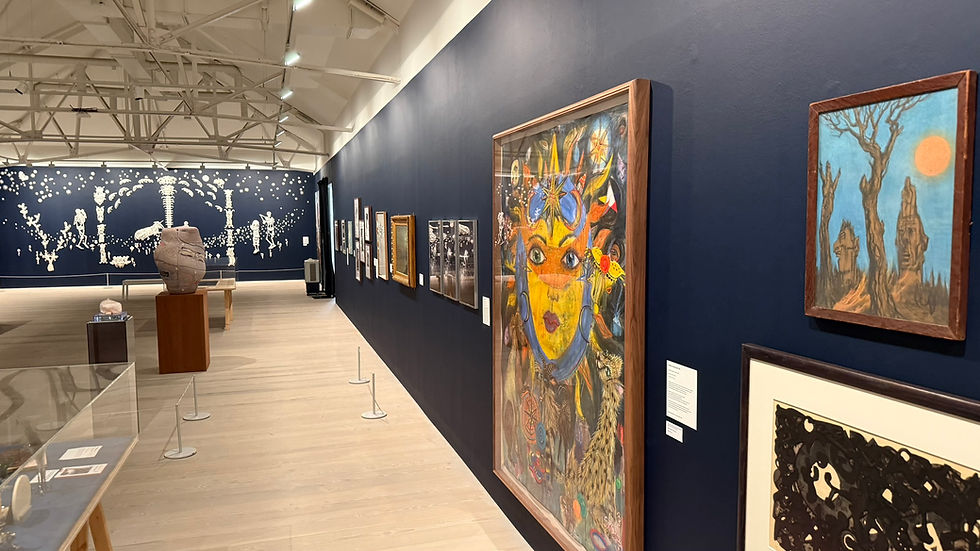
What emerges is less a conventional art-historical survey than a broad meditation on how two celestial bodies have remained central to human culture even as our understanding of them has radically changed.
The Sun and Moon are scientific objects, of course, but they are also among the oldest symbols available to humanity, and the exhibition works best when it allows those meanings to coexist rather than attempting to separate them.
A Sun can signify divinity, renewal, danger, fertility, time, energy or death.
A Moon can suggest transformation, femininity, madness, romance, magic or distance.
Neither the sun or the moon have ever belonged solely to science.
The Sun before science
One of the more compelling aspects of the exhibition is that it intertwines scientific knowledge and myth.
We know what the Sun is, how far away it is, what it is made of and how its energy reaches us, but this knowledge has not eliminated the instinct to invest it with significance, or our imaginations. We still stop to photograph sunsets, travel to see eclipses, organize calendars around celestial cycles and respond emotionally to a full Moon.
The Sun may no longer be a god in the literal sense imagined by ancient civilizations, but its symbolic force has not waned.
That continuity is visible throughout the exhibition, where ancient cosmology, folklore and contemporary technology repeatedly occupy the same conceptual territory.

Textile works and suspended installations are particularly useful in this respect because they move away from the convention of celestial imagery as something framed and viewed from a distance, allowing pattern, repetition and color to occupy the gallery space physically.
The exhibition is strongest when these distinctions begin to break down and questions of category become less important. These are objects of extraordinary visual beauty and the science behind them melts into them.
From the Sun to the Moon
After the intensity of the solar galleries, the move toward the Moon changes the atmosphere considerably.
If Helios fills its room with heat, light and apparent energy, the lunar works tend toward something more reflective, ambiguous and psychologically charged.

Saad Qureshi’s large-scale split moon, suspended within the gallery, is one of the most effective transitions in the exhibition because its dark, cratered surface seems almost to absorb light rather than emit it, creating an immediate contrast with Jerram’s blazing sphere.
The Moon also carries a different cultural history. While the Sun is remote but experientially immediate because we feel its presence every day, the Moon is visually more intimate yet remains physically inaccessible to almost everyone who has ever lived.
It is somewhere humanity has actually reached and walked upon, but it remains a site of imagination, mythology and projection in ways that modern science will likely never displace.
The exhibition moves fluidly between those ideas, shifting from dream states and folklore to the technological history of space exploration.
The variety of approaches is important because it prevents the exhibition from becoming too literal. Some works treat the Sun and Moon as recognizable forms, while others use them as symbols, compositional devices or starting points for ideas about time, memory, ritual and human scale.
Looking up again
There is ultimately something appealingly simple beneath The Sun and The Moon.
Long before galleries, screens, telescopes, digital images or even painting, human beings looked at the same two objects in the sky and attempted to explain them, worship them, fear them, navigate by them and make images of them.
Our scientific understanding has changed almost beyond recognition, but the impulse to be both humbled, intrigued, frightened and in awe exist all in one. It is a source of nourishment and life, represents hope and re-birth, majesty and expectation, but its fierce intensity and the centimeters miracle of its relationship with the earth to which all life depends keeps us mindful of our miraculous and infinitely improbable, tenuous life here on earth.
It is to this tenuos juxtaposition that Chogyam Trungpa Rinpoche perhaos had in mind when he said , “Hold the sadness and pain of samsara in your heart and at the same time the power and vision of the Great Eastern Sun. Then the warrior can make a proper cup of tea”.
The Sun and The Moon at Saatchi Gallery
The Sun and The Moon Saatchi Gallery: Art Inspired by the Celestial runs at Saatchi Gallery, London, from 5 June to 8 September 2026.
Catch it while you can.
FAQs
What is The Sun and The Moon exhibition at Saatchi Gallery?
The Sun and The Moon: Art Inspired by the Celestial is a major 2026 exhibition exploring how the Sun and Moon have influenced art, culture, science, mythology and belief across different periods and cultures. It brings together painting, sculpture, photography, film, textiles, installations and archival material across two floors of Saatchi Gallery.
When does The Sun and The Moon run at Saatchi Gallery?
The exhibition runs from 5 June to 8 September 2026 at Saatchi Gallery in London.
What is Luke Jerram’s Helios?
Helios is a monumental six-metre illuminated representation of the Sun by British artist Luke Jerram, using detailed solar imagery derived from astrophotography and NASA observations to allow visitors to experience the texture and scale of the Sun in an immersive gallery setting.
How large is Helios?
The Saatchi Gallery installation is approximately six metres in diameter and is presented at an approximate scale of 1:230 million, meaning that each centimetre represents around 2,300 kilometres of the actual Sun’s surface.
Did J.M.W. Turner really say “The Sun is God”?
The phrase is famously attributed to J.M.W. Turner and is commonly associated with the end of his life, but the precise circumstances are uncertain, so it is more accurate to describe the words as attributed to Turner rather than established verbatim last words.
Why is “The Sun is God” associated with Turner?
The phrase has become closely associated with Turner because light, atmosphere and the Sun were central to his work, particularly in his later paintings, where recognizable landscape often appears to dissolve into color and illumination.


Comments