
AI Transformation in Art Market Analytics, Provenance, Art Identification, and Collection Management in 2026
Artificial intelligence is, or will very soon be reshaping the global art market, changing how collectors, galleries, advisors, museums and auction houses analyze artworks, pricing trends, provenance records, and market behavior.
From AI-powered pricing analytics to digital provenance systems and infrastructure and artwork recognition tools, new technologies are helping introduce greater efficiency and transparency into a market historically known for resistant or slow technology adoption, fragmented data and subjective valuation methods.
Although it seems now that AI is unlikely to replace traditional connoisseurship or scholarly expertise, it is becoming an increasingly important tool for collectors seeking data-driven insights into artist momentum, market sentiment, authentication research, and historical pricing performance, and the organization, history, and identification of art.

Key Takeaways
AI is helping organize and analyze large volumes of auction and art market data more efficiently.
AI-powered platforms are expanding artwork identification, provenance research, and digital cataloging capabilities.
Machine learning tools can help identify pricing trends, collector sentiment, and emerging artist visibility.
Digital provenance verification and fraud detection systems are becoming increasingly sophisticated.
Object vision and machine learning are identifying and verifying art assets.
Despite advances in AI analytics, art valuation remains heavily influenced by subjective cultural and historical factors.
How AI Is Changing Art Market Analytics
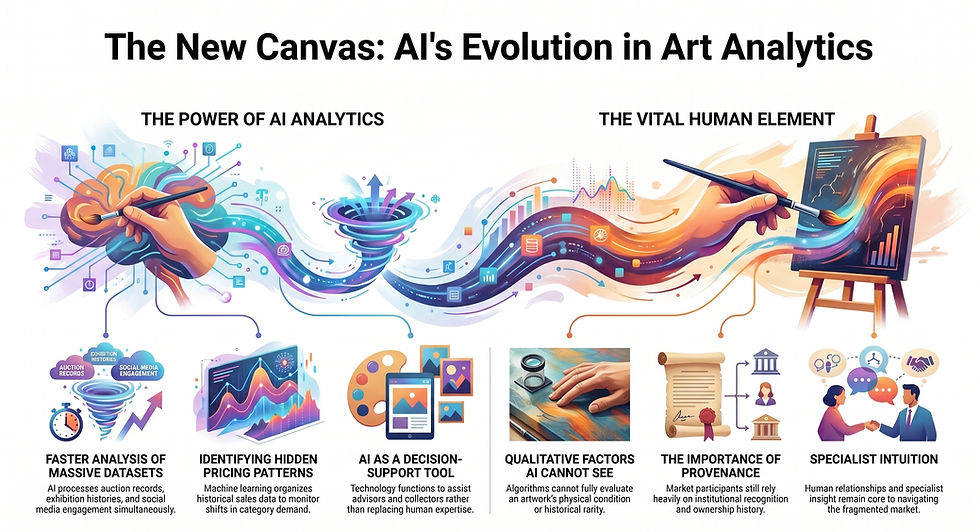
The art market has traditionally relied on specialist intuition, private networks, and limited access to pricing information. Artificial intelligence is beginning to shift that landscape by enabling faster analysis of large datasets, including:
auction records,
exhibition histories,
social media engagement,
gallery activity,
and collector behavior.
Today, art-market platforms use machine learning models to organize historical sales data and identify patterns across artists, mediums, and collecting categories.
These systems can help collectors and advisors compare artworks, monitor market demand, and evaluate historical performance trends more efficiently.
However, AI still functions primarily as a decision-support tool rather than a replacement for human expertise. Factors such as provenance, rarity, condition, museum exhibitions, critical reception, and institutional recognition remain central to determining long-term artistic and financial value.
AI Tools Used in the Art Market
Several companies and platforms are developing AI-assisted systems focused on art market analytics, artwork recognition, and digital provenance infrastructure.
Artrendex
Artrendex is an AI-focused art analytics platforms. The company uses machine learning and visual analysis technology to support:
authentication research,
pricing analysis,
and market intelligence.
Its systems analyze historical sales records and visual data patterns to help collectors, advisors, and institutions evaluate artworks and monitor market activity.
The Fine Art Ledger
The Fine Art Ledger is developing AI-driven technologies focused on artwork identification, provenance support, and digital artwork identity management.
Its AI-powered Artwork Passport™ Search system is designed to help collectors, galleries, museums, auction houses, artists and researchers search and analyze Artwork Passports™ stored within The Fine Art Ledger ecosystem.
The system helps users store art information with the artwork itself, locate artwork records, organize provenance-related documentation, catalog artworks, and navigate digital artwork identities associated with specific works. Central to its functionality, is mobile phone interactivity with physical and digital artworks, allowing almost instant artwork identification and promotion.
.
Rather than functioning as an independent authentication authority, the platform focuses on artwork identification and immutable artwork information storage, and is intended to streamline artwork identification, improve digital recordkeeping, and support more efficient management of provenance and artwork documentation within The Fine Art Ledger’s growing digital product passport infrastructure.
The platform is also soon to release an AI artwork agent intended to simplify artwork identification, inventorying and cataloging workflows for collectors, galleries, artists, museums, auction houses, and institutions.
These developments reflect a wider movement within the art market toward searchable, verifiable, transparent, connected and digitally integrated provenance systems and infrastructure.

AI and Predictive Art Pricing Models
AI-assisted pricing tools are increasingly being used to organize historical auction data and estimate valuation ranges. These systems typically can analyze:
previous sales records,
artist performance,
dimensions,
medium,
auction frequency,
and broader market activity.
While predictive pricing models can provide useful comparative insights, they remain imperfect. The art market is influenced by factors that are difficult to quantify algorithmically, including:
cultural relevance,
museum exhibitions,
collector sentiment,
macroeconomic conditions,
and sudden shifts in taste.
As a result, AI-generated valuations should generally be viewed as supplemental research tools rather than definitive pricing authorities.
AI and Provenance Verification
One of the most significant applications of AI in the art market involves provenance and authenticity research.
Forgery, fraud, and incomplete ownership histories have long presented major risks for collectors, galleries, auction houses, museums and institutions. AI-assisted systems can help organize fragmented archival records, identify inconsistencies in documentation, and compare visual patterns across artworks more efficiently than traditional manual research alone.
Digital provenance systems and searchable artwork databases are also becoming increasingly important for collectors seeking greater transparency surrounding ownership history, provenance and artwork references.
However, experts caution that AI cannot now independently authenticate artworks. Authentication remains a highly specialized process involving, among others:
scholars,
conservators,
scientific testing,
catalogue raisonnés,
and artist foundations.
AI and Art Market Sentiment Analysis
Another emerging application involves sentiment analysis. AI tools can track digital engagement surrounding:
artists,
gallery exhibitions,
museum shows,
art fairs,
and auctions.
These systems help market participants monitor visibility trends and collector interest across online platforms and social media channels. Increased institutional exposure or viral online attention may sometimes correlate with heightened auction activity or gallery demand.
At the same time, sentiment analysis has clear limitations. Long-term artistic significance, scholarly reputation, and cultural influence cannot, it seems, be fully reduced to engagement metrics or algorithmic trends.
AI-Powered Object Vision and Machine Learning Are Transforming Art Identification and Asset Verification
Artificial intelligence, object vision, and machine learning are reshaping how art assets are identified, and potentially authenticated, and verified across the global art market in 2026.
Advanced computer vision systems can analyze high-resolution images, brushstroke patterns, pigments, signatures, canvas textures, and stylistic details with remarkable precision. These AI-powered tools can compare artworks against extensive databases of museum archives, auction records, catalog raisonnés, provenance documents, and historical sales data to identify inconsistencies, detect potential forgeries, and support attribution analysis.
There is an increasing adoption of machine learning technologies to strengthen due diligence, reduce fraud risk, improve collection management, and streamline cataloging processes.
Object vision and machine learning, AI-driven provenance verification is also being integrated with blockchain registries and digital asset management platforms, like The Fine Art Ledger, bridging the divide betwen digital blockchain records and physical assets and creating more transparent and traceable ownership histories for both physical and digital artworks.
Risks and Limitations of AI in Art
Despite rapid technological advances, AI-driven art analytics may still face important limitations.
Unlike equities or commodities, artworks derive value from emotional resonance, historical importance, rarity, institutional validation, and cultural context — variables that are difficult to measure mathematically.
AI systems also depend heavily on available data. Because many private gallery transactions remain undisclosed, large portions of the art market continue to lack transparency. As a result, predictive models often rely disproportionately on public auction records, which represent only one segment of the broader market.
Additionally, excessive reliance on algorithmic analysis may reinforce existing market biases or encourage speculative behavior. Emerging artists, underrepresented regions, and culturally significant works may receive limited visibility if historical datasets remain incomplete or skewed toward established Western markets.
The Future of AI in the Art Market
Artificial intelligence will likely become increasingly integrated into the broader art ecosystem over the coming years. Collectors, advisors, galleries, museums, auction houses and institutions are expected to continue adopting data-driven technologies for:
provenance research and infrastructure,
valuation analysis,
collection management,
artwork cataloging,
artwork identification,
authentication research and support, and
restoration support.
As AI tools become more accessible, smaller galleries and independent collectors may gain access to analytical resources previously available primarily to large institutions.
Emerging systems focused on artwork identification, AI-assisted cataloging and inventorying, and searchable digital artwork identities may also help modernize cataloging standards and improve access to provenance-related information.
Nevertheless, industry specialists tend to believe AI will complement — rather than replace — traditional expertise.
Human scholarship, curatorial knowledge, and connoisseurship remain central to understanding artistic significance and long-term cultural value.
But, if anything, AI, and its rapid development, have shown us that we humans may well tend to underestimate what AI will do and who or want it may replace, and as system and large language models get ever more sophisticated, what we perceive today may well seem comical with hindsight in just a few years time.
Frequently Asked Questions
Can AI accurately predict art prices?
AI can analyze historical auction patterns and market data, but it cannot reliably predict future art prices with certainty due to the subjective and unpredictable nature of the art market.
What are the leading AI platforms in the art market?
Platforms such as Artrendex and emerging systems developed by The Fine Art Ledger are contributing to AI-driven analytics, artwork identification, art management provenance research, and digital cataloging technologies within the art market.
Can AI authenticate artwork?
AI may assist with visual analysis, red flags in style or brushwork and provenance research, but authentication still, for now, requires expert review, scientific testing, conservation analysis, and scholarly evaluation.
How is AI improving provenance research?
AI tools can help organize archival records, compare visual references, identify inconsistencies, and improve access to artwork-related documentation and ownership histories.
Will AI replace art advisors and specialists?
Most industry observers believe AI will function as a supplementary research tool rather than replace appraisers, curators, authentication experts, or art advisors.
From The Fine Art Ledger Editorial Desk
Important Note
This article is provided for informational and educational purposes only and should not be considered financial, legal, or investment advice. AI-assisted technologies may support provenance research, market analysis, and valuation workflows, but they cannot now replace expert authentication, condition assessment, or professional due diligence.Collectors and prospective buyers should consult qualified appraisers, advisors, conservators, auction specialists, or galleries with expertise in the relevant artist or collecting category before making acquisition or investment decisions.


Comments