
How One Modigliani Dispute Reveals the Art Market’s Biggest Provenance Problem—and How Artwork Passports™ Could Have Fixed It
Updated: Apr 24
The Case of Edward W. Greason v. David Nahmad et al.
Key Insight: Risk does not require multiple transfers—only one unverified re-entry into the market.
The dispute in Edward W. Greason v. David Nahmad et al centers on Amedeo Modigliani’s painting Seated Man with a Cane (oil on canvas, circa 1918), owned by Oscar Stettiner, a Jewish art dealer of British nationality based in Paris, prior to WWII.

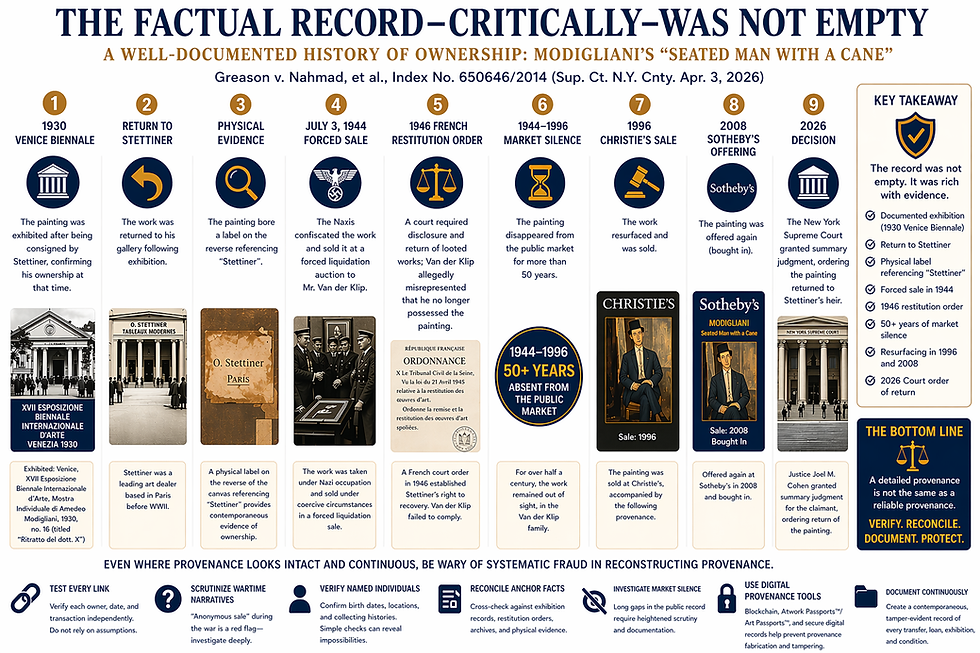
A critical physical detail noted in the case record was a label/notation on the reverse of the painting referencing “Stettiner,” linking the work to its pre-war owner, as well as documented records of the work being consigned by Mr. Stettiner to the 1930 Venice Biennale. Nevertheless, the work, looted by the Nazi’s in 1943, evaded a French 1946 restitution order, a sale at Christies in 1996 and was bought in at a 2008 Sotheby’s auction with an estimate of $18 million to $25 million, only to ordered returned to the heirs of Mr. Stettiner (who died in France in 1948 bereft of his painting) by order of the Supreme Court of New York on summary judgment dated April 3, 2026.
The Facts
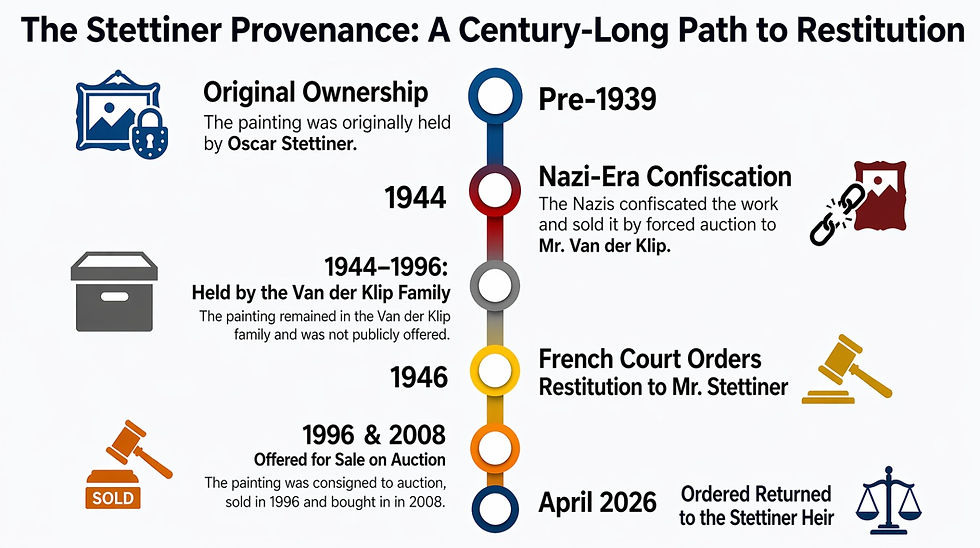
Pre-1939: Painting owned by Oscar Stettiner
July 3 1944: Sold during Nazi occupation through a forced liquidation sale to a Mr. Van der Klip
1946: A French restoration order required disclosure of looted works; purchaser Mr. Van der Klip allegedly provided false responses to inquiries saying the work had been sold on
1944–1996: No public exhibition, offering, or market visibility of the painting has been evidenced
Postwar–1990s: Work remained within the Van der Klip family
1996: Painting surfaced at Christie’s and was sold, despite the unresolved restitution framework
2008: Work was offered at Sotheby’s (bought in), still without recognition of the claim
Post-2008: Stettiner heirs pursued recovery efforts
2014–2026: Litigation culminating in judicial review of fragmented provenance and historical misrepresentation
April 3, 2026: ordered returned on motion for summary judgment to Mr. Stettiner’s heir
The case demonstrates how, amazingly, a documented restitution regime (1946) was bypassed or missed, allowing defective title risk to persist for over half a century.
How Artwork Passports™ Could Have Prevented the Dispute. If Only There Were Time Machine
At its core, this case was not caused by missing history—it was caused by failure to verify known history at the point of sale.
If Artwork Passports™ (Art Passports™), supported by blockchain infrastructure and smartphone-based verification, had existed and been adopted by the art market in the postwar period, the dispute in Gowen would likely never have arisen.
1. Continuous Chain of Title via Blockchain
Each transfer of the artwork—from the 1940s onward—would have been:
Recorded on a tamper-evident blockchain ledger
Time-stamped and cryptographically verified
Linked to a persistent Artwork Passport™ identity
All historical information is digitally accessible in real time in one place
This would have eliminated ambiguity regarding ownership transitions.
2. Real-Time Verification via Smartphones
With modern smartphone access:
Buyers, dealers, and institutions could instantly scan and verify an Artwork Passport™
Provenance, claims, and transaction history would be visible in real time
Any gaps or red flags would be immediately apparent prior to acquisition
This shifts due diligence from retrospective investigation to instant verification at the point of transaction.
3. Mandatory Verification by Auction Houses and Institutions
If auction houses, galleries, and museums required Artwork Passport™ validation as a condition of sale or exhibition:
Works lacking verified provenance would be excluded from the market
Restitution claims (such as Nazi-era claims) would be flagged and attached permanently
Buyers would only transact in works with verified, compliant histories
This creates a market-wide enforcement mechanism, not dependent on individual diligence and settling competing claims.
Despite all the evidence presented by the plaintiffs in Greason, the documented consignment to the Venice Biennale, and its return to Stettiner, the label on the back of the work referencing Stettiner, the two auction houses and their diligence teams, this still resulted in contested litigation spanning many years, where the Defendants (the buyers in the 1996 Christies Auction) disputed Mr. Stettiner’s title to the work and the chain of provenance.
5. Elimination of Evidentiary Reconstruction
Instead of relying on decades-late reconstruction:
Courts would have access to a contemporaneous, immutable record
Litigation based on conflicting narratives would be replaced by objective data
What Is an Artwork Passport™? (Quick Overview)
An Artwork Passport™ or Art Passport™ is a persistent, tamper-resistant record that accompanies an artwork throughout its lifecycle. It typically can include:
When implemented using secure digital infrastructure (such as blockchain-backed registries), artwork passports can create a single source of truth accessible to authorized stakeholders.
Where the System Failed-and How Artwork Passports™ Could Have Fixed It
1. Ownership and Title Disputes
Problem in the Case: Disagreements over rightful ownership often hinge on incomplete or contested transaction histories.
Passport Solution: An Artwork Passport™ would provide a chronologically sealed ownership ledger, where each transfer is:
Verified
Timestamped
Cryptographically signed
This would make it exceedingly difficult to assert conflicting ownership claims without immediate contradiction from the record.
2. Fragmented Provenance
Problem in the Case: Traditional provenance documentation is frequently dispersed across galleries, private records, and archives, leading to gaps or inconsistencies.
Passport Solution: Artwork passports consolidate provenance into a continuously updated, standardized record, eliminating reliance on:
Scattered paper trails
Conflicting expert opinions based on partial data
Vague or deteriorating records, such as the note on the back of the work referencing Stettiner
The result is a unified provenance narrative that can be independently verified.
3. Lack of Transaction Transparency
Problem in the Case: Opacity in art transactions can obscure key facts such as intermediaries, beneficial owners, or conditions of sale.
Passport Solution: While respecting confidentiality where necessary, passports can encode:
Transaction confirmations
Transfers
This creates a selectively transparent framework where critical legal facts are preserved without exposing sensitive commercial details.
4. Evidentiary Challenges in Litigation
Problem in the Case: Courts often face competing narratives supported by inconsistent documentation.
Passport Solution: Artwork passports could conceivably function as high-integrity evidentiary records, reducing reliance on:
Testimonial reconstruction
Post hoc document assembly
Instead, courts can refer to an immutable, blockchain record created contemporaneously with each transaction.
5. Due Diligence Failures
Problem in the Case: Buyers and intermediaries may fail to conduct adequate due diligence, either due to time constraints or lack of access to reliable information.
Passport Solution: A standardized passport enables almost instant due diligence, allowing parties to:
Verify ownership and provenance in real time
Identify red flags before completing transactions
Why This Matters for Collectors, Galleries, and Auction Houses
The lessons from Edward W. Greason v. David Nahmad et al. extend beyond a single dispute. They highlight a structural need for modernization in how artworks are documented and tracked.
Artwork passports offer:
Risk reduction for collectors, galleries, and investors
Improved market confidence through verifiable transparency
Streamlined legal processes with clearer evidentiary records
Enhanced compliance with evolving regulatory expectations
Adoption Challenges (and Why They Are Fading)
Despite their promise, artwork passports face hurdles:
Industry resistance to standardization
Concerns over data privacy
Integration with legacy systems
Governance of passport registries
However, these challenges are increasingly outweighed by the implications of Gowen and the now more prolific, institutionalized forgery systems, which not only rely on fakes and forgeries themselves but also painstakingly recreate the provenance infrastructure and histories to ‘verify’ their fakes. Where provenance research and essential infrastructure have traditionally been relied on as gatekeepers to fraud, these essential lines of defense fail where the entire provenance system is forged.
As Greason shows, reconstructed provenance slipped right through major institutions and buyer diligence. The 1996 Christie's buyers apparently did little, if any diligence, purportedly relying on Christie's to verify and authenticate the work and title.
Nazi-Looted Art Claims: Why This Case Matters
This case must be understood first and foremost as a failure of restitution enforcement.
A 1946 restoration order existed requiring disclosure and return of looted works
A purchaser (Van der Klip) allegedly misrepresented ownership in response, stating that he had parted ways with the work
The painting then disappeared from public view for over 50 years
Major market actors (Christie’s 1996, Sotheby’s 2008) proceeded without resolving the underlying defect
This is not merely a provenance gap—it is a breakdown in institutional verification.
The Critical Insight
While it is sometimes assumed that a tracking system would fail if bad actors input false data, this case shows a different reality:
The Nazis and postwar systems did generate records and paperwork. They were renowned for their fastidiousness in keeping records of their crimes. There is little doubt that if Artwork Passports™ had existed then, the Nazis would have been the first to record the transfer to Mr. Van Der Klip.
The failure occurred because later market participants did not require verification of those records as against the fake provenance offered up by the Van der Klip heirs
Had Artwork Passports™ existed, they would not have been able to forge the provenance, and Stettiner’s name, plus the forced liquidation of his assets would have immutably been stored.
How Artwork Passports™ Would Have Prevented This
The primary protective function of Artwork Passports™ is not that they prevent bad acts at inception, but that they force immediate transparency and verification at the point of market entry.
An Artwork Passport™ would have:
Resolved provenance instantly by presenting a complete, verified chain of title
Surfaced the Nazi-era confiscation immediately, rather than allowing it to remain obscured for decades
Permanently attached the 1946 restoration order and Stettiner claim to the artwork record
Shown the Van der Klip possession in this context, with his heirs’ possession documented down the chain.
Critically, this would have shifted the timeline of the dispute forward by decades.
Instead of:
A hidden defect persisted from the 1940s to 1996 and beyond
The issue would have been Identified, disclosed, and required to be resolved at the first attempted postwar transaction
The Van Der Klip heirs would not have been able to hide their defect in title and Mr. Stettiner’s prior ownership;
The Defendants in Gowen would not have been able to dispute that the painting the bought in 1996 was the exact painting taken from Mr. Stettiner
The Artwork Passport™ would act like a VIN number for the work
If Artwork Passports™ had been required and verified as a condition of sale:
Christie’s (1996) would have been unable to qualify the work for sale without resolving the restitution issue
Sotheby’s (2008) would have been required to reject or explicitly disclose the defect
In effect, Artwork Passports™ would have functioned as a market gatekeeping mechanism, ensuring that the Nazi-era confiscation issue was brought to the forefront immediately, rather than litigated decades later.
Final Takeaway: Provenance Must Be Verified Before Sale, Not After Litigation
The litigation in Edward W. Greason v. David Nahmad et al . illustrates how preventable many art disputes can be.
Artwork Passports™ provide a practical and technologically viable solution—ensuring that provenance is verified at the point of sale and that historical claims, including Nazi-era confiscation, are surfaced immediately rather than decades later.
It is only a pity that despite his efforts and a restitution order in his favor, Mr. Stettiner did not live to see the return of his painting. And that a restitution order did not stop two leading auction houses from offering the work for sale based on allegedly fabricated provenance.
As they say, justice delayed is sometimes justice denied.


Comments